Category: Uncategorized

Much To-Do

Much To-Do

 Milk Bottle Collection

Before I forget (again), I wanted to share this to-do list application with you.  It’s called Teux Deux and the video introduction alone made me want to download it.  Other sites which have caught my eye in this space include Remember The Milk (have I mentioned that before?) and Evernote, which allows you to save your ideas, things you like and things you see.  Are you making a note of this?

All of which reminds me of a lovely line from Gina Trapani, which I saw in Seth Godin’s recent compliation of thoughts, What Matters Now;

“Getting Things Done is not the same as Making Things Happen”

Say it again Gina…

“Getting Things Done is not the same as Making Things Happen”

Gina (the editor of Lifehacker) is making the point here that you can reply to emails/pay the bills/cross off the to-dos… OR you can organize a community/take a risk/set ambitious goals.  She tells us not to “worry too much about getting things done.  Make things happen”.  Good advice.

Of course you could just pay other people to make things happen for you.  In which case you might like Fiverr, “the place for people to share things they’re willing to do for $5”.  Today on the site, someone will write a song for you, write jokes for a speech, photoshop an image of you or give you a wake up call every day for just five bucks.  What are you waiting for?  If you don’t see anything which tickles your fancy, you can post your own ‘gig’, and see who responds.

Now that I’ve (hopefully) inspired you to think about how your fiver could be put to use…perhaps you’d like to use it to fund someone’s creativity?   This is what KickStarter is all about, enabling the crowd-funding of a range of ventures by people from all over the world.  One of this week’s most popular ventures is someone wanting to make a documentary about happiness. To do this, they were asking for a cool $33,000.  Good LUCK, you might think.  Cleverly, they offered a range of packages including digital screenings, physical copies of the finished product and even a meeting with the director.  All to raise their $33,000.  And they did it.  In fact, they have raised (at the time of writing) $36,238 from (and this is the impressive bit) 377 backers. 

So there you have it.  Three of the top excuses for NOT doing something;

  • I don’t have the money to do it
  • I don’t have the time to do it
  • (More honestly) I haven’t been organised enough to get round to it

I give you;

  • Your to-do list application
  • Your ‘making things happen’ site
  • Your crowd-funding platform

“Procrastination is opportunity’s natural assassin” Victor Kiam

“Sometimes opportunity knocks, but most of the time it sneaks up and then quietly steals away”  Doug Larson

Supporting Business

Supporting Business

What role should Government play in business support?

Today, the Government as a whole spends over £3bn a year on business support. BIS (the department for business, innovation and skills) spends roughly £1.7bn of which £950m funds skills, £226 funds export support and £400m is earmarked for innovation.  PWC assert that every £1 spent on business support delivers 7.60 in benefit. 

The future of Business Link seems uncertain.  If you have spent any time around entrepreneurs in the past few years, you know that this news will almost certainly cause eyes to roll, heads to shake and a muttering of ‘good’.  Because knocking Business Link has become cool, just as knocking the ‘Daily Mail’ is also cool. 

Are we seriously saying that Government has no role to play in informing or advising businesses in Britain?  And even if that ‘advice’ is to come from ‘real business people’ are we really happy to agree that Government has no role to play in funding some of that advice?  I’m not convinced.

I’ve been thinking about business support, what Government can or should do, and what part others might have to play.   

A few thoughts, and as you’ll see, I’m not presenting solutions, just raising a few things which I find interesting;

1)  Seeding the idea of ‘self-employment’, as distinct from ‘entrepreneurship’ and ‘business starting’.  I think that this would be a powerful message to take to the million unemployed 18-15 yr olds as they look out into a bleak jobs market.  For many, starting a business (high-growth or otherwise) is not right, however working for themselves might be.

2) Working ‘better together’.  Brokering valuable introductions between potential partners.  For example, between BIS, publishers (for example Channel 4) and brands (for example Apple).  Thinking about questions like ‘who has attention?’ ‘who is loved?’.  The partnerships and co-sponsorship agreements of the next few years will need to be far more sophisticated than just buying space and ‘badging’. Government can (through its power to convene) promote and enable the fostering of these new relationships.

3) Fostering of networks and mapping of social networks.   It remains important to connect the connectors across the UK, especially in deprived areas.  By mapping (with consent) who knows who, gaps will emerge, and this is where some of the most powerful opportunities to connect will present themselves

4) Crowd-sourcing ideas and views.  The coalition is off to a good start on this in other areas.  Ask business owners for VERY specific ideas about how they would reform business support (or cut ‘red tape’ for that matter).  Crucially, then represent those ideas to the crowd and invite people to rate and comment on suggestions.  Work in partnership with others to promote the consultation.  Why not offer a ‘prize’ for any ideas implemented (perhaps offered by a partner?).

5) Rather than thinking about large contracts, why not experiment with small experiments in priming partnerships?  Invest (say) 10k in a relationship with an online partner, invite them to present their results (who they have helped and how), then reconsider how to allocate future funding. Given that ‘information’ and ‘advice’ for business might be seen as separate, why now offer the former as ‘free content’ to publishers, and then consider a way of incentivising them to promote that content?

6) Finally, a ‘big idea’ for unlocking national growth is to unlock the personal productivity of our citizens.  This idea makes conversations around well-being and health unbelievably relevant.  If we can inspire (for example) young people to do what they love, they will be more productive, and the economy will benefit overall.  I wonder if this approach might unlock a very different kind of ‘advice’ and ‘information’ to business from Government?

What do you think?

Tracking the TN2020

Tracking the TN2020

 IMG_2833 by prsarahevans.

I’m in Chicago this week with the British Council for the 2010 Summit of the Transatlantic Network 2020 (TN2020).  It’s a group of just over one hundred people from twenty four countries, who have been selected from a huge range of backgrounds.  In theory at least, these are some of the people expected to be in especially influential positions in one decade from now.  By connecting them and inspiring them to collaborate, the project hopes to make a difference.  I’ll be the Master of Ceremonies for the week, and I’m already enjoying meeting the members.  Although the over-arching theme of the week is the power for technology to drive social change, we are exploring a range of topics in depth.

For our first two days, the group is splitting into five tracks on themes ranging from the role of water in the 21st Century to sustainable buildings and urban planning.  I’ve spent this morning with the team from CeaseFire based here in Chicago, thinking about innovative solutions to violence prevention. 

Some sobering statistics for you…
• In the state of Ilinois, 76% of offenders detained in 2003 were re-arrested by 2006.
• 17,875 children in the state are in foster care.  The average stay is a depressing 50 months.
• 2/3 of inmates have children.
• Black youths are five times more likely to be killed than their white peers.
• In Chicago in 2008, 510 people were killed. 
• In one particular Chicago neighbourhood (Englewood) it is estimated that 60% of the residents have mental health needs.

Here are four things that this morning’s conversations (whether or not covered explicitly) have made me consider;

1) The role for business:  There is an increasing opportunity for the private sector to invest in social outcomes.  This is being explored in the UK through the Social Impact Bond.  If an organisation can prove that they are able to reduce re-offender levels by a certain amount, then this saves the country money, so why should that organisation not be rewarded accordingly?

Business must shoulder some of the blame for the glamorisation of violence and so it has a responsibility to be involved in problem solving.  Perhaps one opportunity could link with the time is takes to build trust on a grass-roots level when working with young people.  Brands are trusted by millions and there ought to be opportunities to leverage that trust (be the brands in sport, music or otherwise) to unlock engagement earlier than could be achieved otherwise.

2) Channelling style and energy:  If a young person is showing high levels of style and energy, it is almost impossible to imagine them agreeing to sit and do nothing as the alternative.  Instead, we have to think of other ways to channel that energy.  This could be into entrepreneurship (and let’s face it, criminals and entrepreneurs must share many of the same traits).  It could be through sport and other physical activities.  Once again, I’m reminded of the potential for brands to invest in the provision of local resources, be they music studios, or sports equipment. 

3) Mapping of social networks:  We heard this morning that 55% of crimes committed by young people in Chicago are by 8% of that youth population. At a time when governments around the world (and particularly in the US and UK) are awaking to the potential for harnessing date, we were warned that in the area of violence prevention, this is not as simple as mapping potholes.  Having said this, I wonder what work has been done in the mapping of social capital within communities.  Isn’t it valuable to know who knows who, and who the influencers are within a particular community?  Is this an invasion of privacy? Having identified the influencers within a community of young people, what forms of engagement would be valuable to spread a message of non-violence?

4) The need for school to change:  Youth violence is often driven by a sense of hopelessness in young people.  They are not being taught the skills they need to solve problems.  Whilst they are busy learning facts and figures in school, techniques around conflict resolution go ignored.  When it comes to paying attention to young people, we miss the opportunity to get involved, be that in counselling or just in listening or taking an interest, at an early stage.  At the risk of veering into the touchy-feely, I wonder if we are being radical enough when it comes to the introduction of techniques for relaxation and stress-relief.  Could activities to encourage meditation, reflection and thoughtfulness be developed at a greater pace?  I’m sure that experiments are taking place all over the world along these lines.  How can we learn which ones work?

I leave this morning feeling pretty uncomfortable about a number of things. The extent to which we celebrate violence in the media is worrying and showing no signs of abating.  It is impossible to sit in a session like this without being reminded of America’s love of guns.  It will be a brave politician who speaks up for the need to radically rethink the purpose and shape of schooling in the US or any other country.  I am concerned by the idea that ‘the state’ should be left to solve these problems alone.

 On a positive note, I am inspired to think about how people share ‘what works’ across cities, regions and international boundaries and how we cross pollinate techniques across sectors and generations.  In a nutshell, this is the hope of the TN2020.  It will be interesting to see what today’s session provokes. 

Goods for Good

Goods for Good

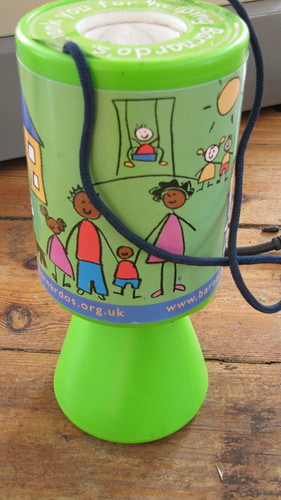
Barnardo's collecting box by HowardLake. 

I had some fantastic and inspiring feedback from my recent post, about the Private MBE’s Club (the members network for honoured citizens) including messages from brilliant people I haven’t caught up with in ages.  Thank you!  It has inspired me to share things more often.  So here goes…

More and more friends seem to be doing amazing things to raise money for good causes.  Running marathons, climbing mountains, jumping out of planes.  The list goes on.  I want to give them money.  But something is niggling me…

My friends, in many cases, are doing something which is immensely personally fulfilling.  Something which, in most cases, they really want to do.  I, in turn, am being asked to fund them, and of course a very good cause.  I want to give money to a very good cause.  I just have thoughts about whether I wish to be funding their adventures and whether this is the best mechanism to get me to part with my money.

Let me explain;   I am parting with my money, they are running the marathon, the cause it getting money.  Forgive me for asking…  What am I getting?  A warm feeling?  The knowledge that I have helped a good cause?  The satisfaction of supporting a friend?  Aside from these intangibles, however important, isn’t the reality that I am getting nothing?  Is there any other way?  Maybe there is.

All over the world, organisations are waking up to the power of social enterprise. They are using business methods to solve social problems.  They are creating goods and services to raise funds.  They do not rely on donations. 

So here’s the idea;

Goods For Good (working title) is a website which allows fund-raisers to sell products to their social networks. 

Imagine you are about to run the marathon.  Rather than rattling your virtual tin, how about getting your friends and supporters to BUY something.  How could it work?  Well,  a portion of the money would cover the costs of the item and delivery, a small amount would go on the handling of the transaction, and all of the PROFIT would go to your chosen cause. 

Goods For Good could launch with a range of core products.  Black Umbrellas, Greetings Cards, Ties, for example.  All things which you can imagine buying, perhaps as a present, and which might carry a decent margin for the cause.

As a fund-raiser (marathon runner for example), you would go to the site, choose your products, choose your price-point (there would be a minimum) and use the sites social tools to tell all of your Facebook friends that you had launched your own Goods For Good Page.   

Goods for Good would handle all of the delivery and fulfilment from a central location, charging a small amount per package.  You, at Cancer Research, Oxfam, or Save the Children, could have your own, branded version of the site, for your existing supporters. 

What do you reckon?  Look out Just Giving.  Here comes Goods For GoodLet me know if you would like to plot with me…

Private MBE’s Club

Private MBE’s Club

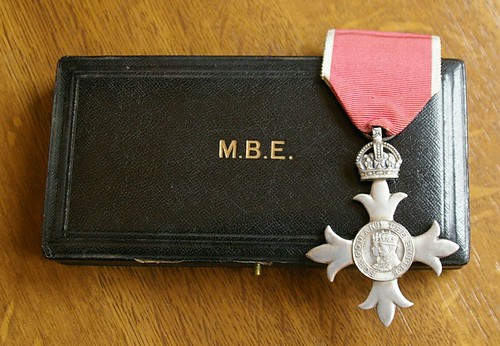
MBE by psmithson.

The Most Excellent Order of the British Empire is an order of chivalry, established in June 1917 by King George V.  It includes five classes in civil and military divisions (GBE/GBE, KBE/DBE, CBE, OBE, MBE).

Just last week,  Her Majesty’s Birthday Honours were announced, including recognition for Professor Brian Cox and actress Catherine Zeta Jones.

Reading through the list, I was struck by just how tiny a percentage are what you might call ‘well known’.  The vast majority are so-called ‘ordinary, hard working people’ from a wide range of backgrounds and walks of life.

It gave me an idea;

Why don’t we create a Private MBE’s Club for Great Britain?

Why not seize the opportunity to offer the recipients of honours with an invitation.  An invitation to join a network of people, all over the country, who have an interest in making a difference.  Yes, it’s important to recognise achievement and there should be a ceremony and gathering.  But what happens next?

The Private MBE’s club would allow people from all over the country to connect with each other at a range of gatherings (both events and online).  Just imagine you had just been honoured.  Rather than returning to your community, what if you had the chance to join forces, even a few times a year, with others from around the UK?

This could be an amazing resource for the nation.  Perhaps the network could be asked questions.  Perhaps it could be mobilised at certain times of the year, or in times of national need.  Maybe through partnership with existing organisations, it could be given somewhere to live or meet?

What if you can’t think of anything worse?  What if you are humbled and more than a little embarrassed by your honour?  That’s fine.  You could decline the chance to join the Private MBE’s Club.

If we have a system in place for spotting and recognising people who have served their country, why waste the opportunity to connect them with each other, knowing that they could be greater than the sum of their parts?